
As the world we live in crumbles in anticipation of a third World War, unprecedented economic deterioration, and multiple genocides, the media shows a different reality – from Red Carpet events to celebrity culture. Meanwhile, the real issues at stake spiral into endless doomscrolling.
The reality we live in today echoes Suzanne Collins’ “The Hunger Games,” where two alternate universes of wealth and misfortune coincide; one group of people starves to death, as another vomits up food to eat more, while the struggles, woes, and deaths of the working class are mere entertainment to the aristocrats.
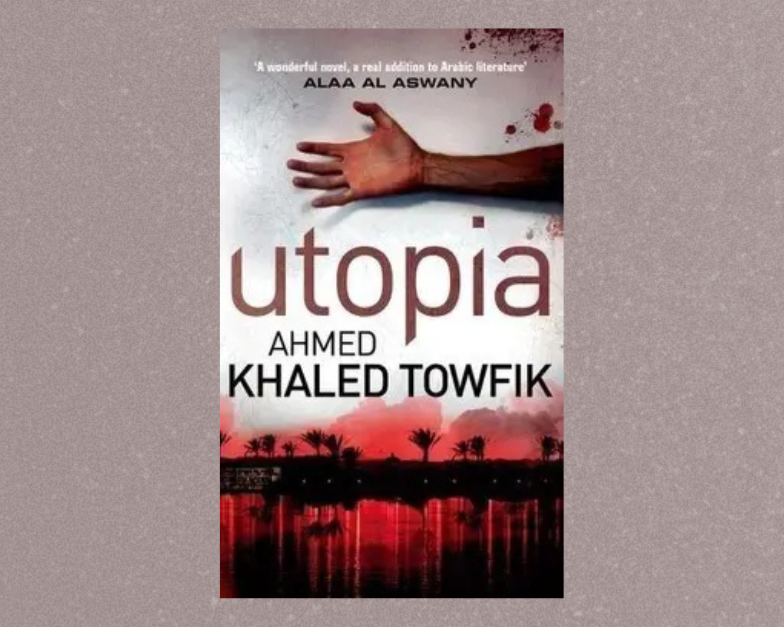
This sense of dystopian absurdity is also present in Ahmed Khaled Tawfik’s “Utopia.”
Ahmed Khaled Tawfik (1962-2018) was an Egyptian author who wrote over 200 books, exploring themes of horror, thriller, and science fiction. Drawing on his background as a physician, he pioneered the medical thriller genre in Arabic literature. For this reason, he is widely regarded as the godfather of contemporary Arabic popular fiction and is credited with influencing generations of Arab readers.
Utopia, published in 2008, was the first novel released outside the Modern Arab Association and ranked second on the best-selling books list at Merit Publishing.
Set in a dystopian future, the novel centers around a fictional society divided into two parallel realities: Utopia, an aristocratic community comprising a scarce elite minority, enclosed by walls and guarded by Marines, and the land of Others, inhabited by the impoverished majority. In Utopia, everything is available and reachable – fancy food, endless entertainment, and even sex. Happiness is served on a golden plate. Meanwhile, in the land of Others, people roam the streets aimlessly, fighting for their food, while dirt covers their eyes, and lust blinds their souls.
Bored with this affluent life, a young Utopian boy, who introduces himself as Alaa, decides to venture to the land of Others alongside his girl, Germinal. On the other side of the wall, Jaber, a poor, well-informed boy from the land of Others who struggles to feed himself and his sick sister, Safiya, shelters the Utopian boy and Germinal.
In his narration, Tawfik alternates between two perspectives – that of the Utopian boy portrayed as the hunter and that of Jaber’s portrayed as the prey.
Tawfik deliberately pits the two characters against each other as parallel embodiments of their respective social realities. Put in the same positions, the two characters make distinct moral decisions reflecting opposing judgments. When violence is mere entertainment to the hunter, the prey utilizes violence as a form of getting back at the geographical and circumstantial unfairness. Sexual desire, for Jaber, resembles defiance of classism and injustice. While for the hunter, it is a mere entertainment. The hunter eventually hunts, and Jaber is preyed upon in inevitable disappointment.
Through this, Tawfik suggests that the environment plays a more essential role in shaping morality than human conscience.
Despite the alternating perspectives of narration, Tawfik maintains a consistent tone, adopting a cynical approach devoid of emotional attachments or sentiments, which unsettles the readers without risking alienation. Tawfik stays neutral, explicitly narrating violence, sex, or humiliation with no moral outrage. The voice shifts from cruel, emotionally numb, and empty, to bitter, lucid, and resentful as the narration alternates from the hunter’s to the prey’s perspective. Yet the tone sustains moral hostility.
The hunter remains unnamed throughout the whole story, as if no name could contain him – not out of lack of identity, but limits. His anonymity is a product of his malice and not his absence. Tawfik strips him of the simplest human right of having a name, because the hunter does not resemble a man; he resembles a system consumed with cruelty and entitlement.
What makes the novel compelling is Tawfik’s weaponization of discomfort to induce moral shock, forcing readers to confront systemic injustice. However, the narrative’s focus on two fully realized protagonists overshadows the female characters, Germinal and Safiya, who remain observational or victimized. Further, despite the powerful message, the plot follows a linear trajectory from calm to chaos, culminating in an anticipated resolution of the hunter-prey dynamic. The ending, in which an oppressed community predictably rises against injustice, risks undermining the novel’s earlier cynical tone by resolving conflict in a manner that feels expected rather than unsettling.
Utopia serves as an awakening rather than a source of emotional reassurance. Tawfik unravels social injustice and lays bare the consequences of systemic oppression on Arab societies. Using parallelism between the two opposite realities, he demonstrates how moral judgment is conditioned by the environment; under conditions of extreme luxury or menacing impoverishment, empathy erodes. Exploiting feelings of discomfort, he compels readers to reflect on their own social realities, suggesting that unless change emerges from within society itself, the walls separating Utopia from the land of the Others will continue to rise.
As my first read of Tawfik, Utopia has encouraged me to delve deeper into his work. The novel is an excellent choice for readers interested in dystopian fiction that confronts social disparity and prioritizes provocation over comfort or reassurance.
