
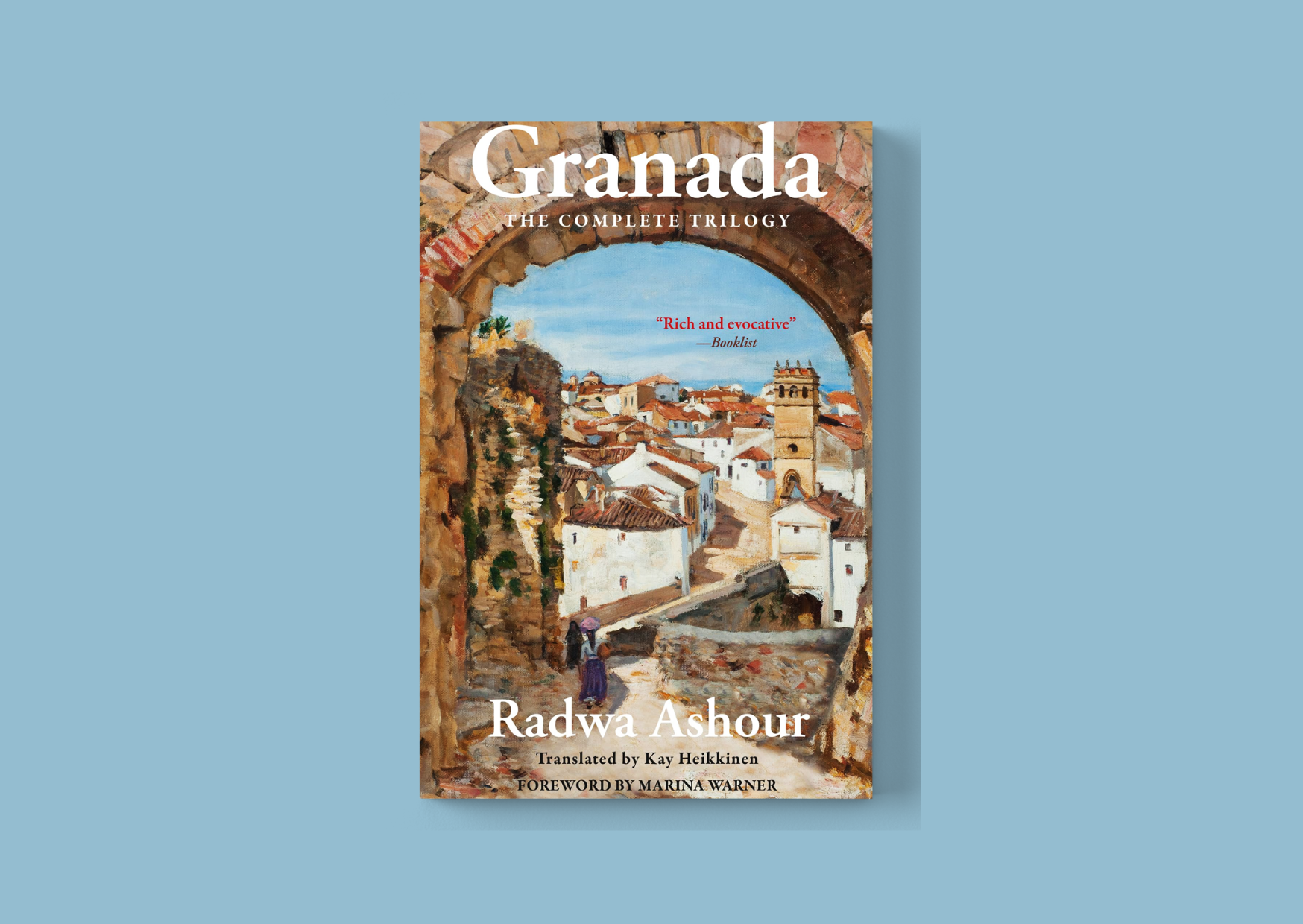
Colonialism, deportation, and apartheid: history repeats itself. Actors change, yet politics prevail, as individual stories lose to mass graves. The Granada Trilogy by Radwa Ashour follows consecutive generations of the Muslim family of Abu Jaafar and his children after the fall of Granada in 1492.
Radwa Ashour (1946-2014) was an Egyptian novelist, university professor, and activist who published numerous novels, short stories, and critical works. She was married to the Palestinian poet Mourid Barghouti, with whom she shared a deeply aligned political vision shaped by questions of exile, identity, and resistance. Her legacy lies in the lasting impact of her literary works across the Arab world.
Originally written in Arabic, The Granada Trilogy consists of three novels: Granada, Maryama, and Departure. It was published in several editions. First, Granada in 1994, then Maryama and Departure in 1995; the trilogy was later translated into English. The Granada Trilogy is regarded as a classic of Arabic literature, recognized for its cultural and academic significance.
The Trilogy is set in the Emirate of Granada, the last Muslim stronghold of Al-Andalus. It follows successive generations of the Muslim family of Abu Jaafar as they struggle to preserve Islamic culture. Following the fall of Granada, the Catholic Monarchs imposed systematic measures to subjugate the Muslim population, progressively forcing them to abandon their traditions, language, and religious identity. Muslims were stripped of their Arabic names and lineage, forbidden from wearing the veil, observing Ramadan, performing Islamic burial rites, or practicing prayer. They were ultimately coerced into converting to Christianity. Their homes were subjected to violent raids, and Islamic and Arabic books were burned before the very eyes of the Muslims of Granada. Amid these authoritarian policies, the novel follows the resilience of Abu Jaafar’s family and their descendants, sustained by the lingering hope of reclaiming the lost glory of Al-Andalus.
Abu Jaafar and his family endure the persecution that the new rulers of Granada impose for decades. Deeply affected by the burning of Arabic and Islamic books, Abu Jaafar, a calligrapher, dies of anguish. In response to these policies, every member of the family reacts differently. Hasan, Abu Jaafar’s son, reluctantly complies with the new order to protect the family. Salima, Abu Jaafar’s daughter, retreats to her own world of books and potions. And Saad, Salima’s husband, chooses rebellion and joins those who defy the authorities. Naim, previously an employee of Abu Jaafar, carries on with minimal disruption. As the hope of reclaiming the lost glory hovers, the family members resume their lives under the façade of Christianity, while quietly preserving their Arab and Islamic traditions. Hasan marries Maryama, they have a son, Hisham, who later marries Saad and Salima’s daughter Aisha, and together they have a son, Ali.
Granada
Granada, the first novel, focuses on the lives of Abu Jaafar and his children, Salima and Hasan, demonstrating the immediate aftermath of the end of the Muslim rule. It follows the direct impact of the fall of Granada on the Muslim communities, capturing the cultural shock and sense of denial that marked the first stages of the Christian expansion in Granada.
Maryama
In Maryama, the second novel, repression and scrutiny intensify, and Maryama is the central figure who struggles to keep the family coherent. This era is marked by silent resistance and a yearning to reclaim Granada’s legacy. However, the emotional toll escalates with Salima’s burning following accusations of witchcraft, Saad’s death after being consumed by grief for his wife, the loss of Hasan and Naim, and the displacement of Maryama and Ali from the home they had long known. It climaxes with Maryama’s death, signifying the end of an entire generation of Abu Jaafar’s family.
Departure
In contrast, Departure, the third novel, follows the journey of the last descendant of the family, Ali, as he is repeatedly displaced and ultimately compelled to determine his own fate. Across the trilogy, the gradual disintegration of the family mirrors the historical decline of Granada itself: what begins as a stable and unified household is progressively fragmented, until both the lineage and the world it embodies come to an end with Ali.
Ashour explores how people respond to oppression differently. Hasan embodies the dilemma of survival under coercion between dignity and responsibility. He remains cautious and adapts to the new order, while silently preserving the Islamic identity in a way that does not raise suspicions. Saad, on the opposite pole of Hasan, portrays defiance and refusal to compromise. Rather than overt resistance, Maryama conveys endurance under prolonged suppression and quiet opposition. Ali, ultimately, personifies loss and displacement, where nothing is left to preserve. With the exile of Ali, the lineage of Abu Jaafar is extinct, and the culture it represents ceases to exist.
The author employs a simple, lyrical prose, reflecting the everyday life of an ordinary Muslim family. This linguistic simplicity aligns with the characters’ social and emotional worlds, making their experiences accessible and relatable to the reader. Ashour maintains a nostalgic and tragic tone throughout the novel, which immerses the reader in the emotional weight of a historical collapse such as the fall of Granada, fostering a deep sense of empathy with the characters. While it strengthens the novel’s thematic depth, the sustained tragic tone can at times feel overwhelming and ultimately diminish the impact of the characters’ suffering.
Although the wide range of characters enriches the narrative, it also compromises the reader’s emotional investment, making it difficult to form a deep intellectual and emotional attachment to any single character. As a result, multiple narrative threads remain underdeveloped. Saad’s involvement with resistance, his traumatic amputation, and even his death are not fully explored. Naim’s personal decisions to separate from his family and join Hasan and Maryama lack sufficient justification, while key figures such as Hisham and Aisha fade without resolution. Following the deaths of Hasan and Maryama, Ali is left without closure regarding his parents, reinforcing a sense of narrative incompleteness.
While the historical collapse of Granada places a profound emotional and moral burden on the characters, it is transmitted to the reader through their actions and conduct. The Granada Trilogy itself functions as a form of cultural resistance that preserves historical memory, ensuring that the oppression of Muslims in Granada is not forgotten. It is, in fact, more relevant now than ever. As centuries of civilization and history face ongoing erasure, and as mass-scale ethnic cleansing unfolds in Palestine and Lebanon, alongside the occupation of one people by another under religious justification, the suffering of the family of Abu Jaafar, marked by violence, displacement, inferior treatment, cultural suppression, and resistance, resonates deeply with the people of the Levant. It reminds us that a civilization, even when torn from its homeland, is not so easily erased.
The Granada Trilogy serves as a living memory of the exiled people of Al-Andalus. It is particularly suited to readers drawn to understanding history through the ordinary lives of individuals rather than through political narratives. The work appeals to those who appreciate slow-paced storytelling and emotional depth, and who are willing to sit with discomfort and heavy themes.
