
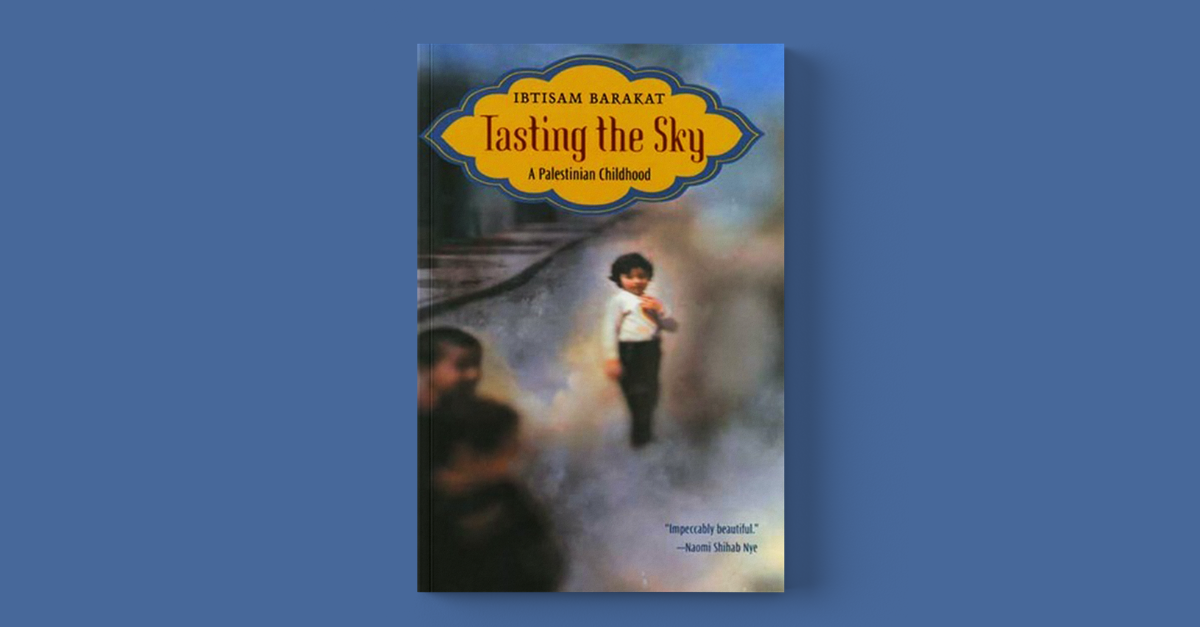
Imagine you are three and half years old, a war has just started, your family is about to flee and you are unable to tie up the one shoe you had on. In the split of a second, everyone you’ve known your entire life has disappeared – gone. All while the Israeli enemy is spreading terror everywhere.
Published in 2007, Tasting the Sky: A Palestinian Childhood is Ibtisam Barakat’s first book and winner of the Arab American National Museum Book Award for Children’s/YA Literature. Palestinian-American bilingual author and poet living in Columbia, Missouri, Barakat founded Write Your Life seminars and actively advocates for peace and speaks out against social injustices.
Barakat’s memoir begins in 1981, when teenage Ibtisam is stopped at an Israeli army checkpoint, on her way back to her home in Ramallah. The protagonist tries to gather her thoughts as she hears the soldier saying, Ramallah should be gone by now.
Flashbacks. Painful flashbacks of the Six-Day war of 1967 resurface once again.
Barakat takes us back to wartime, to the day her life as a young girl completely pivots, to the day fear became constant. Omnipresent. Roaming, haunting her and her family. Verily, haunting the reader in every page.
As Ibtisam and her older brothers, Muhammad and Basel, are playing outside their country house in Ramallah, her father arrives announcing the start of war. He quickly ushers them to leave.
Upon her parents’ command, young Ibtisam tries to put on her only pair of shoes. But in the blink of an eye, her family has already fled. She is left all alone in the darkness, under the sounds of gunshots.
A few hours later that same night, Ibtisam is reunited with her family as she follows a stream of fleeing strangers heading to the Jordanian borders. From that day onwards, home continuously changes from a friend’s kitchen to a single-room house. Although Barakat and her family had found refuge, these places always lacked a sense of belonging, which made the young protagonist constantly feel homesick – a recurrent feeling experienced by all members of Ibtisam’s family, adults and children alike, and rendered to the reader throughout the entire memoir.
Several months later, the Barakat family goes back to their house in Ramallah. To their surprise, Israeli soldiers had settled nearby and built trenches to train for combat. What used to be their safest haven turned into prison.
With time, the Barakats get used to the presence of Israeli soldiers close by. They adapt, playing in the trenches, locking the front door, building walls, concealing windows… Their unmatched perseverance to safeguard their house shows the reader that home is more than just a place. Home is a place that embodies memories. Memories that define us – our identity, our sense of belonging and purpose. And losing it unwillingly is like losing a piece of ourselves.
What stands out most about this memoir is the writing perspective. The reader quickly gets accustomed to three-year-old Ibtisam’s unfiltered point of view. With a naturally simple, flowy writing style, the story often feels like the diary of a young girl. Full of raw emotions and transparent thoughts, Tasting the Sky offers the reader a preview of what it is like growing up in times of conflict.
The reader relives every moment of joy – or even trauma – with young Ibtisam. From the time she and her siblings steal a cart full of sweets and devour it in seconds to the horrific moment their father slaughters their baby pet goat, Zuraiq, for her brothers’ circumcision ceremony. We also get glimpses of a young girl’s developing relationship with a strict Arab mother whose utmost duty is to protect her children in such difficult times.
Another key element in Barakat’s memoir is the power of knowledge and learning. As soon as young Ibtisam is introduced to Alef – the first letter of the Arabic alphabet and her closest friend – letters, words, reading, and writing become her sacred way of escaping reality and chasing freedom. As both Arabic and Hebrew languages start their alphabets with Alef, that first letter serves as the symbol of aspiration for pacification and stability. It is also a gateway for freedom of expression and communication.
Barakat’s vivid descriptions and gripping prose allow the reader to witness the horrors of war and the consequences it has on innocent children. Yet, in spite of it all, young Ibtisam and her brothers prove that resilience comes at a very young age… Through the simplicity of her narration and accounts, the reader eventually understands that despite living in a time of war and displacement, the futility of life often prevails. Lastly, sharing her own story inspires readers to unite and ignites rays of hope for peace.
