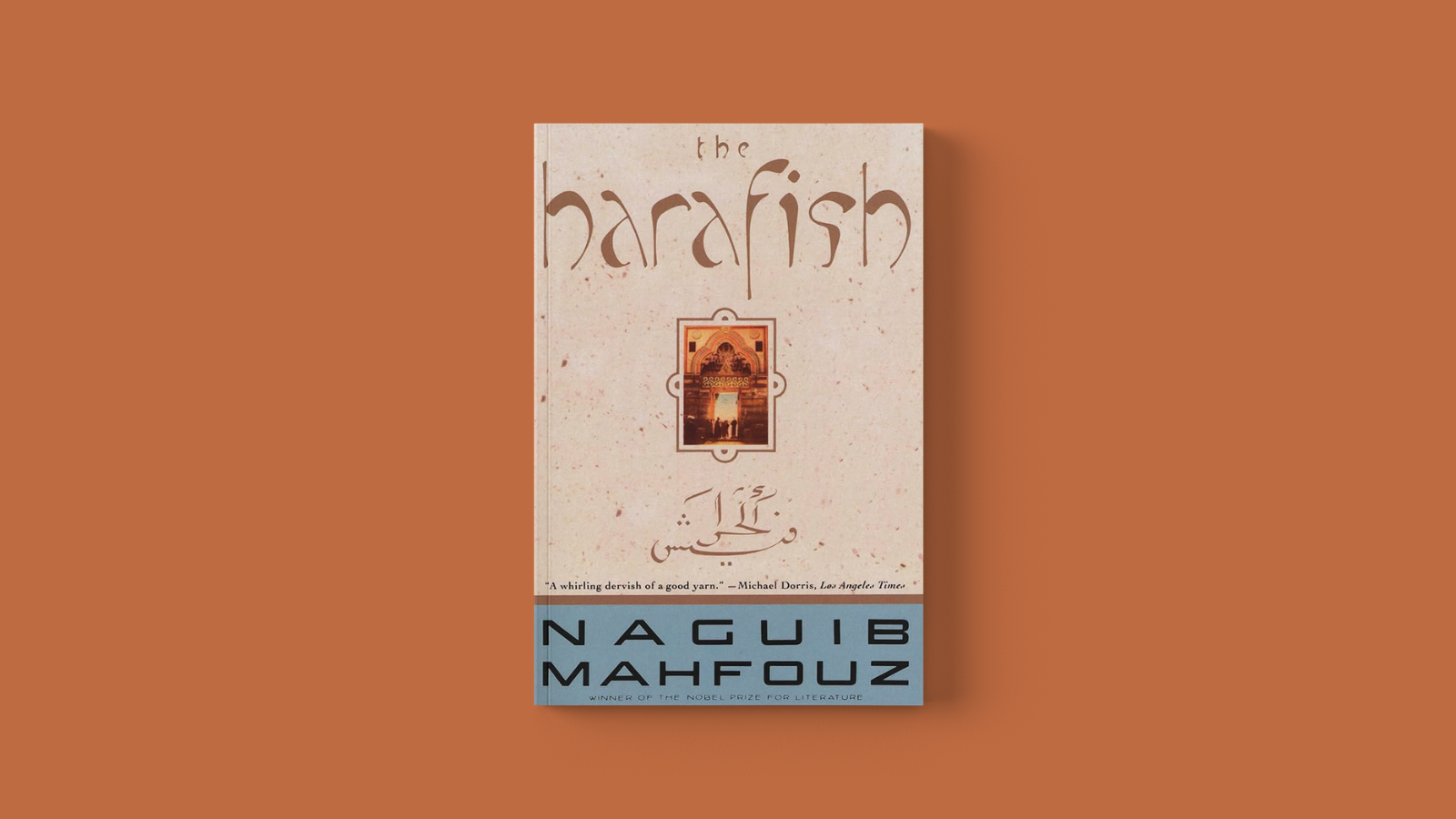
In Arabic, the word “harafish” refers to the working class and those with little economic or political power. It is often used dismissively or derogatorily. However, Naguib Mahfouz reclaims the term by presenting the harafish as the neighborhood’s moral backbone rather than its lowest social class.
Naguib Mahfouz was an Egyptian writer and the sole Arab recipient of the Nobel Prize in Literature (1988), among other prizes including the Egyptian State Prize for Literature and the Order of the Nile, securing his place as one of the most prominent and influential Arab writers in history. Throughout his career, he published more than 35 novels, over 350 short stories, and numerous screenplays and other literary works. Many of his writings were later adapted into films and television series. Published in 1977, The Harafish is among Mahfouz’s most celebrated novels and has, itself, been adapted into several Egyptian films and television series.
Structured as ten interconnected novellas, the story follows the successive generations of the Al-Naji family, beginning with its founder, Ashour Al-Naji. Mahfouz traces how his descendants gradually fall into immorality, drifting further away from honesty, integrity, and justice upon which their ancestor built his legacy. Through these successive generations, Mahfouz explores the relationship between power, authority, morality, corruption, and justice, illustrating how vices such as greed, pride, and the pursuit of power shape both individuals and the society they govern.
The narrative unfolds across the different generations in one alley, starting with Ashour Al-Naji, a gentle and deeply moral man whose example every descendant is measured against. After he mysteriously disappears, his family takes turns leading the alley, and most begin with good intentions only to be pulled away by lust, wealth, comfort, or the fear of death. Some are destroyed by jealousy and murder, others by exile and betrayal, and Galal even chases eternal life through witchcraft before he is poisoned. A few, like Qurra and Fateh Al-Bab, try to hold on to Ashour’s values, but their goodness rarely lasts and is often punished. Still, the memory of Ashour never fully dies, and the story ends with his great-grandson, also named Ashour, who stands with the poor of the alley, defeats its ruler, and revives the righteous legacy his ancestor began.
Mahfouz maintains a neutral tone throughout the novel, narrating with objectivity and rarely expressing emotions directly, leaving readers to draw their own emotional conclusions. His narration employs simple language that remains consistent with the tradition of classical Arabic storytelling. However, the narration noticeably weakens in the final novellas, particularly in Novella Ten, where several events, character arcs, and even sentences become repetitive. Although the novel intentionally relies on parallelism and circularity, many of its storylines are recycled with increasingly predictable outcomes. This is especially evident in the ending, where Ashour, the last descendant of Al-Naji, follows in the footsteps of the founder of the lineage. The conclusion is easy to anticipate from the beginning; even the recurrence of the name “Ashour” foreshadows the cyclical ending long before it arrives.
Beyond its minor shortcomings, the novel remains a great means of thematic exploration as Mahfouz explores human nature in its many forms and its relationship with different expressions of power and authority. Through the successive generations of the Al-Naji family, he illustrates how power corrupts, greed strips people of their humanity, physical beauty is temporary, and pride becomes humanity’s greatest enemy. Ultimately, he suggests that morality is not inherited through bloodlines or established through reputation but is defined by one’s choices and actions in the face of temptation. One of Mahfouz’s greatest strengths lies in the novel’s structure. By dividing The Harafish into ten interconnected novellas, he transforms the history of a single family into the history of an entire society, allowing recurring themes of justice, corruption, power, and morality to unfold through different generations and perspectives. Although many storylines mirror one another, this repetition reinforces the novel’s central idea that the struggle between virtue and corruption is cyclical and must be fought anew by every generation. The variety of characters and the uniqueness of some of their storylines, particularly Zuhaira’s and Galal’s, further enrich the novel and briefly break its repetitive cycle, making them among the most memorable figures in the narrative.
Despite its strengths, the novel’s execution occasionally falls short. Although The Harafish is a symbolic literary work confined within the walls of the alley and deliberately detached from outside influences, its estimated span of more than five centuries often feels unconvincing. Throughout this vast period, traditions remain largely unchanged, human behavior shows little evolution, and the actions of Ashour Al-Naji’s lineage continue to be remembered in remarkable detail, creating the impression that only the Al-Naji family progresses through history. Similarly, character development often lacks sufficient buildup and psychological justification, with several major transformations occurring abruptly rather than emerging naturally from the characters’ experiences. This is particularly evident in Galal Junior’s sudden descent into corruption after his mother’s death, which receives little explanation beyond the event itself. Likewise, although repetition serves the novel’s cyclical structure, many later generations fall into increasingly predictable patterns, making Ashour’s final awakening feel less like the culmination of a moral journey and more like the result of a supernatural calling from his great ancestor, whose name he happens to share. Furthermore, Mahfouz critiques the culture and social stereotypes surrounding women through characters such as Fullah, Rhidwanah, Zuhaira, and Halima Al-Baraka, who are all victims of the same misogyny generation after generation, exposing the persistence of prejudice, violence, and objectification.
In conclusion, Mahfouz presents the gradual rise and decline of morality across successive generations, using a circular narrative to bring the story back to its beginning and provide a sense of closure. Through this cyclical structure, he suggests that the struggle between justice and corruption is recurring, and that preserving morality requires constant effort rather than relying on the legacy of one’s ancestors.
