
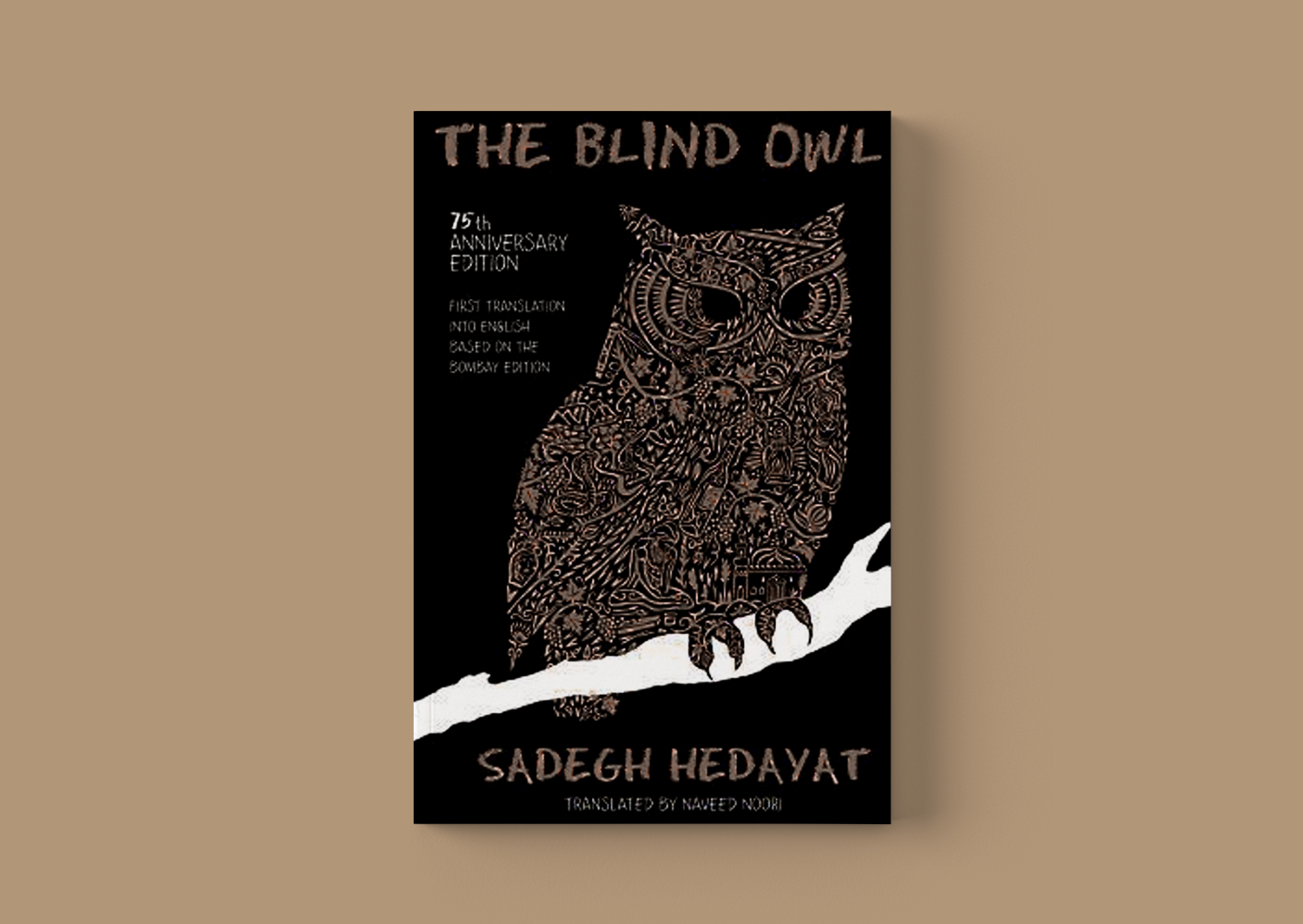
While existentialism emphasizes an individual’s search for meaning, absurdism acknowledges the impossibility of attaining certainty in an irrational world. Both philosophies are profoundly reflected in Sadegh Hedayat’s The Blind Owl. Isolated and alienated, the narrator struggles to find meaning amid psychological fragmentation and blurred boundaries between reality and hallucination. Ultimately, the narrative engages with nihilistic philosophy, as death permeates the novel and life is portrayed as inherently meaningless.
Sadeq Hedayat (1903-1951) was an Iranian author, distinguished for his role in introducing modernism into Iranian literature. Unlike traditional Persian prose, Hedayat engages with philosophical and psychological themes – surrealism, absurdism, alienation, and existentialism. A gothic novel, The Blind Owl is regarded as his most influential piece and a defining example of modernism in Persian literature.
It was published in 1937 and follows an unnamed narrator who lives a fragmented existence between reality, memory, and hallucination, as he recalls his obsessive fixation on a mysterious woman. The narrator’s obsession with the woman stems from his memory, after which he sees her lying dead on his table. In the absence of any sort of logical explanation and self-preservation, he dismembers her body and buries her beneath a tree at the sight of an old man with a hunchback. As reality merges with hallucination, figures repeatedly reappear in distorted forms, including the mysterious woman, the narrator’s wife, the hunchbacked old man, and the tree.
The narrative is a one-sided, cynical monologue that suggests an unstable perception of reality and emphasizes the character’s total isolation. By his own admission, the narrator writes solely for the shadow on his wall, in the absence of any real audience, other perspectives, and any form of communication with the few characters he mentions.
The novel is divided into two parts: the first follows confusing, surreal events in which the narrator’s unstable perception mirrors the reader’s confusion, and the second shifts to reality, though the unstable perception persists. By the second part of the story, the narrative folds back into itself without offering a resolution. Figures reappear in altered forms and for various purposes, primarily to highlight the narrator’s state, while descriptive language and symbolism depict the narrator’s conflicting desires. This ambiguity not only casts confusion and discomfort, it later deepens the meaning intended by the author.
The Blind Owl is a compelling read for those interested in exploring the psychological and philosophical aspects of human behavior. By drawing on discomfort and ambiguity, Hedayat forces readers to experience a sense of instability and psychological fragmentation that directly mirrors the narrator’s own unraveling. Leaving the ending open-ended, the author denies his readers closure and certainty, eventually leaving them to their own internal conflict, stirred by the inconsistent figures in the novel. Nonetheless, Hedayat’s masterpiece remains a milestone in psychological fiction.
