
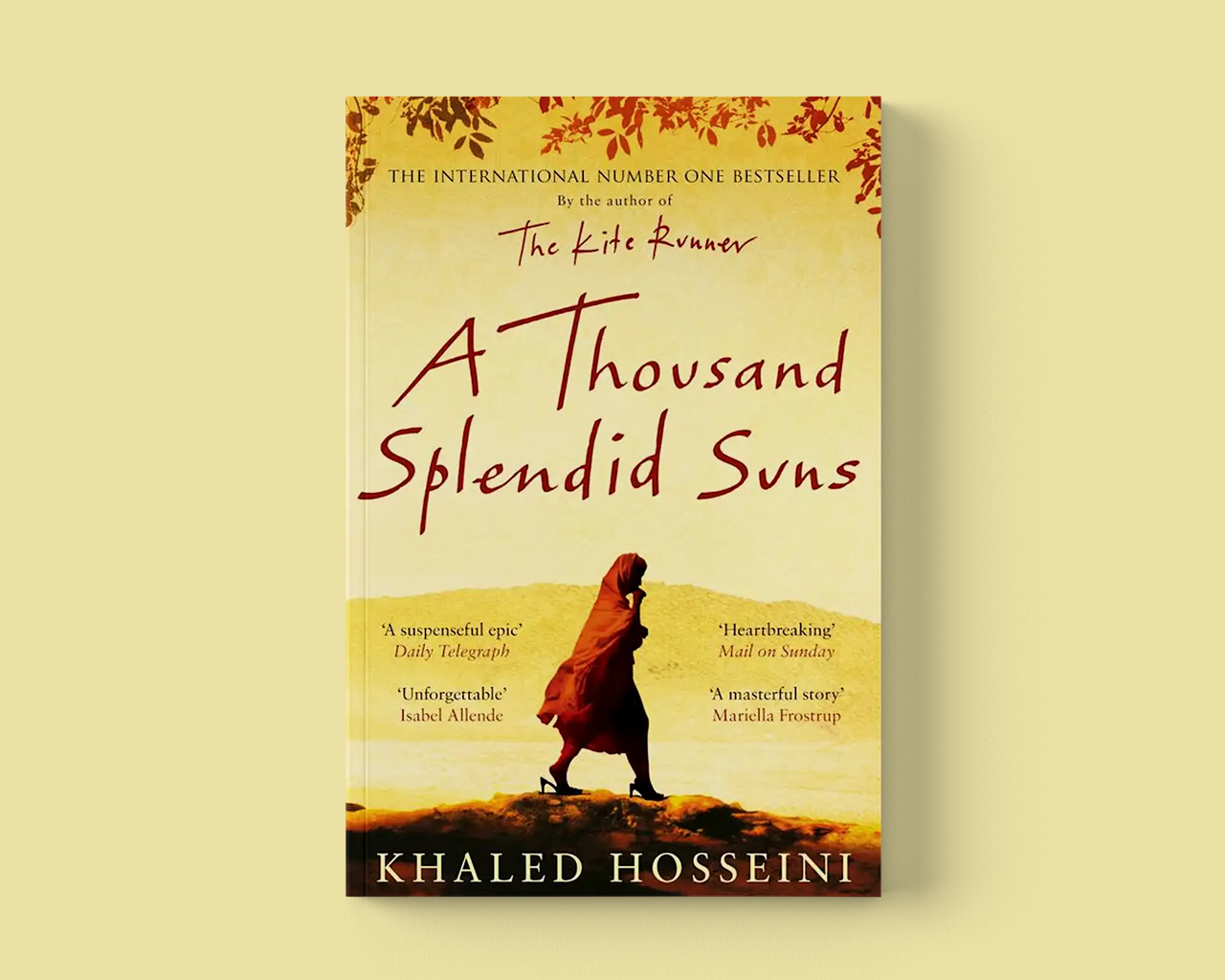
A few weeks ago, the Taliban issued a law in Afghanistan permitting men to beat their women and children, provided they do not leave any fractures or open wounds. With this law, domestic violence is treated as a matter of discretion rather than a criminal offense, and women and children continue to suffer under the rule of the current patriarchal regime. This news story mirrors the underlying reality that inspired Khaled Hosseini’s A Thousand Splendid Suns.
Khaled Hosseini (1965-present) is an Afghan-American author, a UNHCR ambassador, and a former physician who has dedicated most of his literary works to shedding light on the suffering of Afghan civilians following the Soviet invasion and under the rule of the Taliban. His works have received several nominations and awards, and his tales have gained global recognition.
Published in 2007, A Thousand Splendid Suns is a historical, realistic fiction novel, marked as a mother-daughter narrative that explores family dynamics with a focus on the female characters and their roles in Afghan society, portraying their suffering under war and patriarchy. This novel has received several awards, including the “British Book Award” and “Book Sense Book of the Year Award.”It also became the “Number One New York Times Best Seller” for 15 weeks.
The novel is set in Afghanistan in the period spanning the 1960s to 2000s under the rule of the Taliban. It tells the story of two women, Mariam and Laila, whose lives intertwine under the same household ruled by a single man, their husband, Rasheed. Mariam, an illegitimate child, is forced to marry the much older Rasheed and permanently move to Kabul after her mother’s death. She suffers years of loneliness, verbal, and physical abuse by her husband before meeting Laila. Laila grows up surrounded by warmth and learning in Kabul, sharing her early years with her closest friend and first love, Tariq. To escape the toll of war, Laila’s parents decide to flee Kabul for Pakistan, but just before their departure, a rocket strikes their house, killing them both and leaving Laila as the sole survivor. Devastated by the loss of her parents and tricked into believing her childhood friend had died, Laila is forced to marry Rasheed. Due to their fundamental differences, Mariam and Laila view each other as rivals. But after Laila gives birth to Aziza, Rasheed’s violence intensifies as he had hoped for a son, and the bond of rivalry between Mariam and Laila turns into a bond of solidarity. The story peaks when Mariam kills Rasheed to protect Laila and accepts execution by the Taliban, allowing Laila to escape, build a new life, and eventually return to Kabul with the determination to rebuild her country.
While the stories of Mariam and Laila are fictional, they are set within a real historical context that features several events, starting with the Soviet invasion in 1979, the subsequent civil war between Mujahideen factions, and the rise of the Taliban. Hosseini describes how the political situation in Kabul lurks on the premises of each home. Under the rule of the Taliban, women are progressively stripped of their rights, and harsh restrictions are imposed on them; girls are banned from schools, women are prohibited from working, and a strict dress code is enforced. Women’s presence in society diminishes under the guise of religion, customs, and law. Hosseini tells the tragedies of Afghan history through the daily lives of Mariam and Laila, through their marriages, their homes, and their quiet sacrifices.
Rasheed is the portrayal of patriarchy and traditional authoritarianism – emotionally distant, controlling, and physically and verbally abusive. He is also rigid about traditional gender roles, desires a son, and despises Laila for giving birth to a girl. Instead of a psychologically complex character, Rasheed appears as an oppressive antagonist whose power is reinforced by systematic misogyny and gender hierarchy. This renders Rasheed a one-dimensional character whose behavior is based on mere cruelty. In emphasizing the systematic oppression of women, Hosseini sometimes risks simplifying the political complexity of Afghanistan’s history.
Nonetheless, Hosseini sustains an emotional tone and sentimental language throughout the whole story. The author’s intimate narration allows readers to witness the hopes, fears, and quiet acts of resilience. When Mariam holds onto the little education Jalil gave her as a child and learns to read books through her close relationship with Laila, it is a futile act of defiance, but a form of self-preservation. Naming her daughter Aziza, meaning the cherished one, is Laila’s way of holding onto the hope born from her past with Tariq. Hosseini alternates the narration between the perspectives of Mariam and Laila, allowing the reader to experience the events through the eyes of each woman’s inner world. Nonetheless, shifting the narrative between Mariam and Laila creates a dynamic exchange between the two protagonists and highlights their contrasting backgrounds and personalities.
Almost 20 years later, and somehow Hosseini’s words still ring true. A Thousand Splendid Suns is the kind of story that stays with you because you grow attached to the women and feel their pain as if it were your own. It carries the reality beyond the headlines, past the wars and politics, and into the lives and tragedies of the people caught inside them. Rather than presenting a collective image, it concentrates on distinct, individual perspectives shaped by history. It is an excellent choice for readers who enjoyed reading Hosseini’s debut novel, The Kite Runner, and those interested in historical fiction that blends intimacy within the context of historical events.
